

The Biggest Myth About Running and Your Knees
If you’ve been told that running will wear out your knees, the research says otherwise. Recreational running is not associated with higher rates of knee osteoarthritis and may even support long-term joint health. While knee pain is common among runners, it is usually related to training loads exceeding tissue capacity rather than “wear and tear.”1,2,3
Relevant Knee Anatomy and Common Injuries
When discussing the most common injuries, it is helpful to also talk about the anatomical structures that are typically involved.
The knee is one of the largest joints in the body and is responsible for absorbing and transmitting forces with every step you take. During walking and running, the knee experiences repetitive loading thousands of times throughout training and daily use. Because of these repetitive demands, several different structures within and around the knee can become irritated when training loads exceed the body’s ability to recover. Understanding the anatomy can help us understand why these are the most common injuries.4
The Patella (Kneecap) and Runner’s Knee
The patella, or kneecap, sits at the front of the knee and glides within a groove on the femur as the knee bends and straightens. This structure helps improve the leverage of the quadriceps muscles and plays an important role in activities such as running, squatting, and climbing stairs.
Patellofemoral Pain Syndrome (aka Runner’s Knee)
One of the most common causes of knee pain in runners is patellofemoral pain syndrome. In fact, it is so common that it is often referred to as runner’s knee. This condition is typically aggravated by running, particularly downhill, climbing stairs, squatting, or sitting for prolonged periods. Many runners report a dull ache in the front of the knee that gradually worsens with activity.
Common symptoms:
- Dull, aching pain around or behind the kneecap.
- Pain that worsens with running, squatting, stair climbing, or prolonged sitting.
- Clicking, grinding, or a sensation of knee stiffness during movement.
What Treatment Usually Involves
Treatment often focuses on reducing irritation while gradually improving the knee’s ability to tolerate load. This may include temporary modifications to running volume, strengthening of the quadriceps and hip muscles, and a progressive return to running.
Articular Cartilage and Osteoarthritis
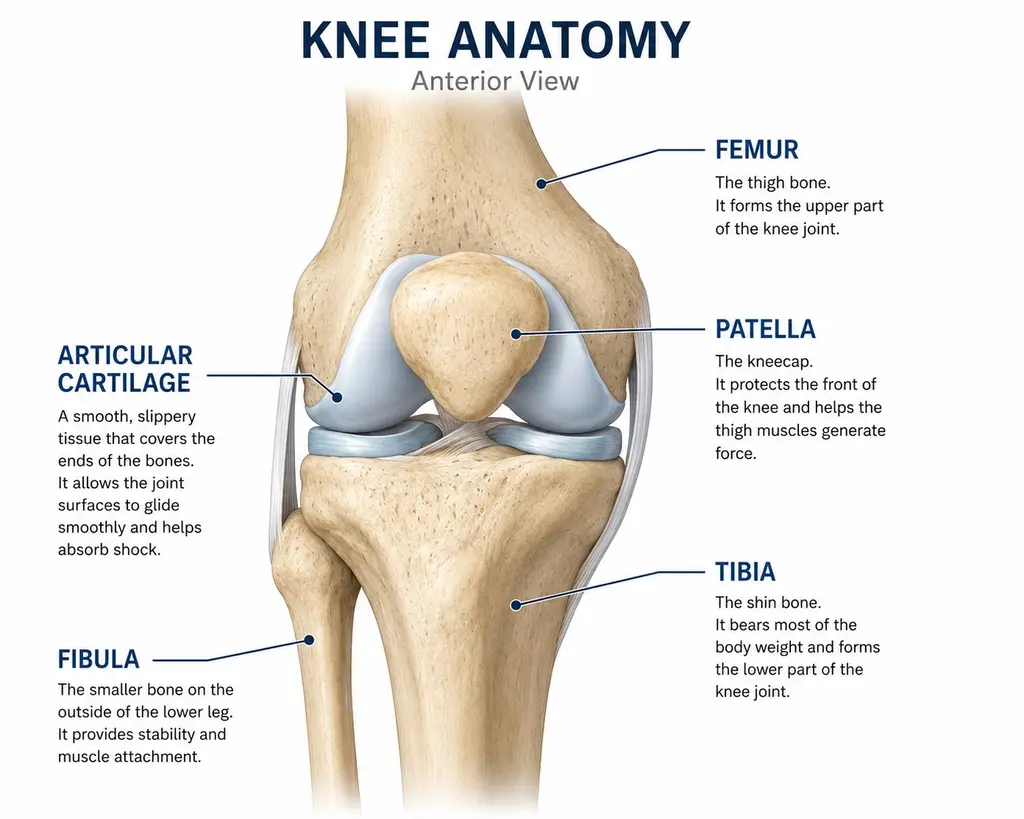
The ends of the femur, tibia, and underside of the patella are covered with a smooth protective layer known as articular cartilage. This cartilage allows the joint surfaces to glide smoothly against one another while helping distribute forces throughout the knee.
Knee Osteoarthritis
Knee osteoarthritis is more common in older runners and is often characterized by stiffness, aching, and reduced mobility. Unlike many running injuries, osteoarthritis symptoms tend to develop gradually over time rather than appearing suddenly.
Common symptoms:
- Aching knee pain that worsens with activity and improves with rest.
- Morning stiffness or stiffness after prolonged inactivity.
- Reduced knee mobility, swelling, or grinding sensations (crepitus).
What Treatment Usually Involves
Contrary to popular belief, treatment rarely involves complete rest. Instead, most treatment plans focus on maintaining activity, improving strength, managing symptoms during flare-ups, and gradually increasing the knee’s tolerance to exercise. For many runners, staying active is one of the best things they can do for their long-term joint health.
The Quadriceps and Patellar Tendons
The quadriceps muscles on the front of the thigh connect to the kneecap through the quadriceps tendon. The patella then connects to the shinbone through the patellar tendon. Together, these tendons help to straighten the knee and transfer force through the knee during running, jumping, sprinting, and other athletic activities. Doing too much too soon is usually the process that irritates these tendons, resulting in patellar or quadriceps tendinopathy.
Common symptoms:
- Pain at the top or bottom of the kneecap where the quadriceps or patellar tendon attaches, respectively.
- Increased pain with running, jumping, squatting, or climbing stairs.
- Symptoms may improve after warming up but return afterward or the following day.
What Treatment Usually Involves
Successful treatment typically focuses on progressively loading the tendon so that it can better tolerate the demands of running. This often includes a structured strengthening program, modifications to training volume or intensity, and a gradual return to higher-demand activities.
The Iliotibial (IT) Band and IT Band Syndrome
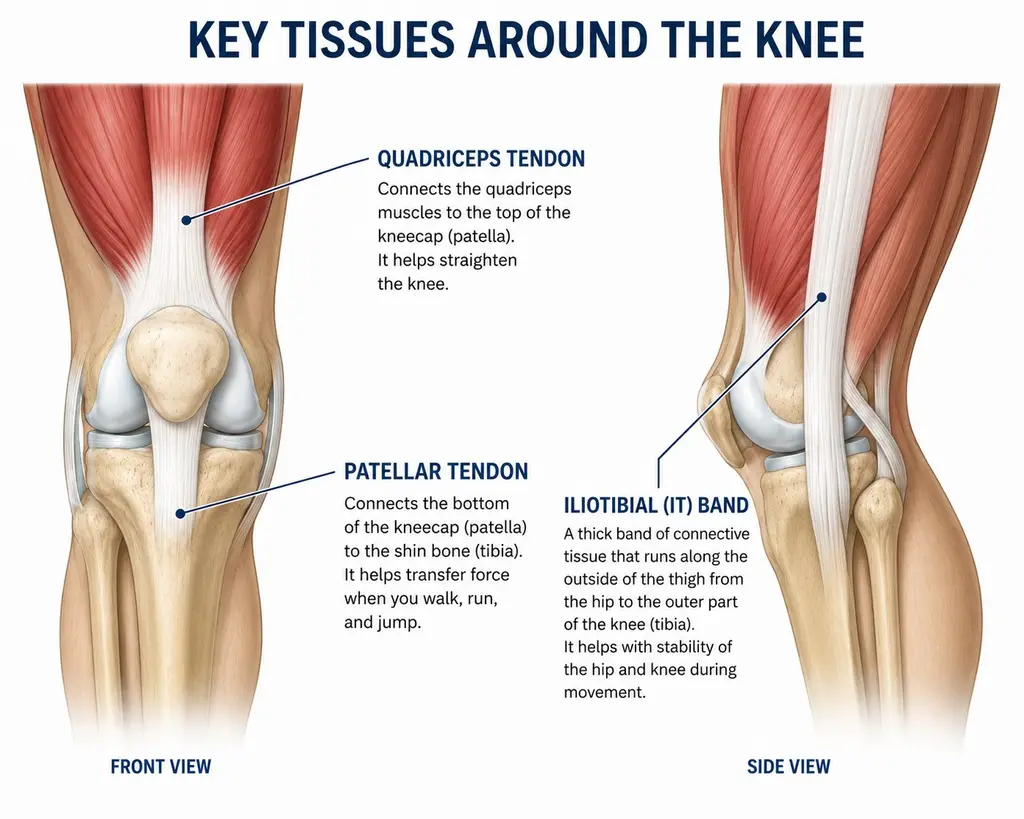
The IT band is a thick band of connective tissue that runs along the outside of the thigh from the hip to the outer portion of the knee. It helps contribute to lower-extremity stability during walking and running and is subjected to repetitive loading with every stride. Similar to other overuse injuries, like quadriceps and patellar tendinopathy, a recent increase in training volume is commonly associated with the onset of pain in this area.
IT band syndrome is one of the most common causes of pain on the outside of the knee in runners. Symptoms are typically felt on the lateral aspect of the knee and often begin after a certain distance or duration of running.
Common symptoms:
- Sharp or burning pain on the outside (lateral aspect) of the knee.
- Symptoms that increase during running, especially downhill or over longer distances.
- Tenderness when pressing on the outside of the knee.
What Treatment Usually Involves
Treatment typically involves managing training loads while addressing factors that may be contributing to excessive stress on the lateral knee. Strengthening the hips and lower extremities, improving movement capacity, and gradually returning to running are common components of care.
Other Causes of Knee Pain
While the conditions discussed above account for many cases of running-related knee pain, they are not the only possible causes. The knee is a complex joint, and symptoms can sometimes originate from structures within the knee itself or even from areas outside of the knee. Conditions such as meniscus tears, Baker’s cysts, stress fractures, and referred pain (particularly from the lumbar spine) can all present with knee pain and may mimic more common running injuries. Because many knee conditions share similar symptoms, a thorough evaluation is often necessary to determine the true source of pain and guide appropriate treatment.
The Importance of the Knee’s Position in the Kinetic Chain
While most people look directly to the knee when knee pain develops, the structures above and below the joint play an important role in how forces are distributed during running. The hips, ankles, quadriceps, calves, and surrounding connective tissues all work together to help control movement and absorb impact.
When one area becomes overloaded or is unable to keep up with training demands, symptoms can develop in other areas that must then compensate. Understanding the anatomy involved can help runners better appreciate why proper training, recovery, and strength work are essential for keeping the knees healthy.
When Should You Seek a Professional Evaluation?
You should consider seeking a professional evaluation if you experience:
- Knee pain that persists or worsens despite reducing your running volume, resting, or modifying activity.
- Significant swelling, loss of motion, or difficulty performing normal daily activities such as walking or climbing stairs.
- Locking, catching, buckling, or a feeling that the knee is unstable or may give way.
- Pain following a twisting injury, fall, or direct impact to the knee.
- Pain that is present at rest, wakes you up at night, or is accompanied by localized bone tenderness that may indicate a stress fracture.
Frequently Asked Questions
Should I keep running if I have knee pain?
It depends on the severity and type of pain. Mild discomfort may improve with reduced mileage, rest, and corrective exercises, while sharp, worsening, or persistent pain may indicate an injury that requires professional evaluation. Continuing to run through significant pain can increase the risk of further injury.
Should I get imaging for my running-related knee pain?
Not all cases of running-related knee pain require imaging, as many conditions can be diagnosed through a thorough history and physical examination. Imaging may be recommended if symptoms are severe, follow a traumatic injury, involve significant swelling or instability, or do not improve with conservative care.
Can diagnostic ultrasound help identify the cause of my knee pain?
Yes. Diagnostic ultrasound can provide a cost-efficient and real-time evaluation of tendons, ligaments, bursae, and other soft tissues around the knee, helping identify common injuries and sources of pain without the need for radiation.
Can chiropractic care help with running-related knee pain?
Sports chiropractic care can help address biomechanical issues that contribute to knee pain, such as poor joint mobility, muscle imbalances, altered gait patterns, or alignment problems in the hips, pelvis, and lower extremities. Treatment may include joint adjustments, soft tissue therapy, movement assessment, and corrective exercises.
How can I prevent knee pain when running?
Preventive strategies include gradually increasing training volume, wearing appropriate running shoes, strengthening the hips and leg muscles, improving running form, maintaining flexibility, and allowing adequate recovery between workouts. Regular movement assessments can also help identify issues before they lead to pain.
Conclusion
Experiencing knee pain while running is quite common and can stem from a variety of causes, but some conditions are far more common than others. Patellofemoral pain syndrome, IT band syndrome, patellar and quadriceps tendinopathy, and knee osteoarthritis are all frequent sources of discomfort for runners. While these conditions can share similar symptoms, each has its own underlying causes and responds best to specific treatment strategies. The good news is that most running-related knee pain can be successfully managed with the right combination of load modification, strength training, mobility work, and a gradual return to activity. Identifying the root cause of your symptoms is often the first step toward getting back to running comfortably, confidently, and pain-free.
If your knee pain is persistent, worsening, or limiting your ability to run, book a thorough evaluation with us at M3 Chiropractic & Sports Medicine, and we can help determine the cause and develop the right treatment plan for you.
References
- Lo GH, Musa SM, Driban JB, et al. Running does not increase symptoms or structural progression in people with knee osteoarthritis: data from the osteoarthritis initiative. Clin Rheumatol. 2018 Sep;37(9):2497-2504. doi:10.1007/s10067-018-4121-3. PMID: 29728929; PMCID: PMC6095814.
- Alentorn-Geli E, Samuelsson K, Musahl V, et al. The Association of Recreational and Competitive Running With Hip and Knee Osteoarthritis: A Systematic Review and Meta-analysis. J Orthop Sports Phys Ther. 2017 Jun;47(6):373-390. doi:10.2519/jospt.2017.7137. PMID: 28504066.
- Silbernagel KG, Thomeé R, Eriksson BI, Karlsson J. Continued sports activity, using a pain-monitoring model, during rehabilitation in patients with Achilles tendinopathy: a randomized controlled study. Am J Sports Med. 2007 Jun;35(6):897-906. doi:10.1177/0363546506298279. PMID: 17307888.
- Mellinger S, Neurohr GA. Evidence based treatment options for common knee injuries in runners. Ann Transl Med. 2019 Oct;7(Suppl 7):S249. doi:10.21037/atm.2019.04.08. PMID: 31728373; PMCID: PMC6829001.