
Let’s break down what’s happening inside the shoulder, how these injuries occur, how they’re diagnosed, and what effective treatment should look like to ensure lasting recovery — not just temporary relief.
What Is the Rotator Cuff?
The rotator cuff is a group of four small but powerful muscles that stabilize the shoulder joint and allow smooth, controlled motion in all directions. These muscles include:
- Supraspinatus – initiates shoulder elevation and is most commonly injured.
- Infraspinatus – helps externally rotate the shoulder.
- Teres minor – assists with external rotation and stabilizes the joint.
- Subscapularis – internally rotates the arm and provides front-side stability.
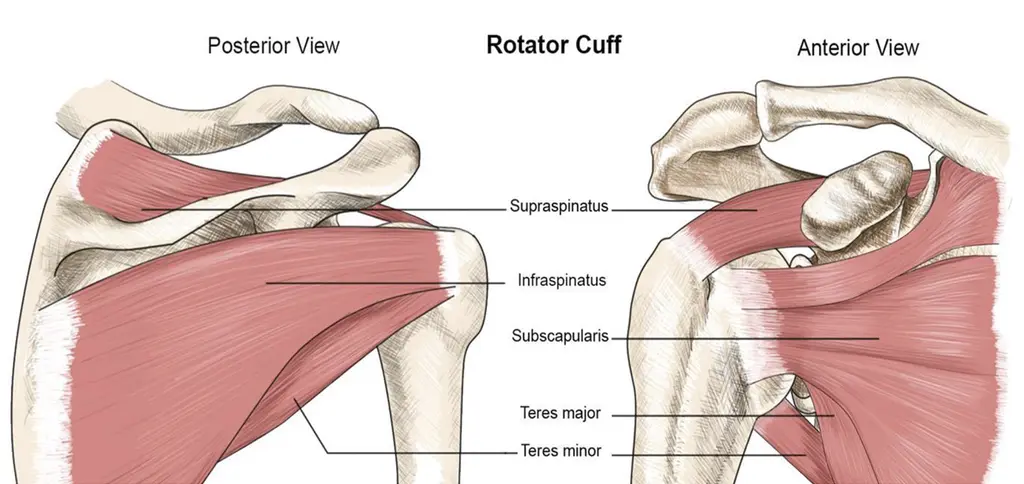
Together, these muscles keep the head of your upper arm bone (the humeral head) centered within the shallow shoulder socket (the glenoid) — even during explosive actions like throwing, pressing, or serving.
Understanding the Spectrum of Rotator Cuff Injuries
Not all rotator cuff injuries are the same. They exist on a continuum ranging from mild inflammation to severe tears involving multiple tendons. Knowing where you fall on that spectrum is key to setting realistic treatment expectations and recovery timelines.
- Tendinopathy: The tendon becomes irritated or degenerative due to overuse, poor mechanics, or repetitive loading. Pain is often dull, activity-related, and typically improves with rest. Strength and motion remain largely intact. Conservative rehab is highly effective at this stage.
- Partial-Thickness Tear: Some tendon fibers have torn, but the tendon is not fully detached from the bone. Pain tends to be sharper and more consistent, especially with lifting or overhead activities. Strength may be mildly reduced, but most patients can still function with discomfort. Most partial tears respond well to structured, conservative care.
- Full-Thickness Tear: The tendon has completely torn through, often leading to noticeable weakness and difficulty lifting or rotating the arm. Depending on tear size and function loss, surgery may be considered, though many full-thickness tears improve significantly with targeted rehab and strengthening.
- Massive Tear (Multiple Tendons): When two or more tendons are torn, it’s classified as a massive tear. These injuries cause marked weakness, limited motion, and compensatory neck or shoulder blade pain. Treatment depends on age, goals, and activity level — ranging from surgical repair to advanced conservative rehab.
Diagnosis: How It’s Identified
A thorough evaluation begins with a detailed history, physical exam, and movement assessment.
At M3 Chiropractic and Sports Medicine, we assess:
- Pain or weakness with shoulder motion
- Limited range of motion
- Compensation patterns
- Scapular mechanics and control
If a significant tear is suspected, or conservative care fails to relieve symptoms, imaging — particularly diagnostic ultrasound — can help confirm the size and severity of the injury.
Why Imaging Matters
When a rotator cuff tear is suspected, diagnostic ultrasound provides a fast, accurate, and cost-effective way to visualize the tendons in real time. It helps identify tear size, inflammation, and tissue quality — all without radiation.
For active individuals, this clarity is crucial. Knowing whether the issue is a mild tendinopathy or a full-thickness tear helps set realistic expectations for recovery and return to sport. Imaging also ensures that care is directed appropriately — whether that’s conservative rehab or surgical referral — and helps guide safe progression back to activity.
Treatment and Rehabilitation
The good news? Most rotator cuff injuries — including many partial and even some full-thickness tears — respond extremely well to a structured, conservative care plan. The key is moving beyond passive rest and focusing on restoring movement, strength, and shoulder control. Some things to expect in rehab are:
1. Control Pain and Calm Inflammation
Early treatment focuses on reducing irritation and allowing healing to begin.
This may include:
- Soft tissue therapy (ART, Graston, cupping) to decrease tension and improve circulation.
- Chiropractic adjustments to restore scapular and thoracic mobility, reducing stress on the shoulder.
- Shockwave or laser therapy to stimulate tissue repair and decrease chronic inflammation.
- Activity modification — maintaining gentle, pain-free movement to preserve joint health.
2. Restore Mobility and Movement Control
Once pain is manageable, the focus shifts to improving shoulder and upper-back mobility while retraining coordinated movement.
- Improving thoracic extension and rotation helps reduce load on the shoulder.
- Relearning scapular mechanics ensures proper shoulder blade positioning for overhead motion.
- Incorporating isometric and eccentric exercises (like gentle internal and external rotations) safely reintroduces load to strengthen healing tendons.
3. Rebuild Strength and Dynamic Stability
As symptoms improve, progressive loading helps rebuild strength and stability.
- Strengthening scapular stabilizers (serratus anterior, lower trap, rhomboids) supports healthy shoulder function.
- Progressive rehabilitative exercise focuses on restoring full strength, coordination, and tissue capacity to handle athletic or daily demands.
4. Reinforce Function and Return to Sport
The final phase prepares the shoulder for every day activities and higher-level performance.
- Dynamic stability drills (wall balls, drop-catch drills, plank variations) improve control under load.
- Kinetic chain training connects lower-body power and core stability to shoulder function.
- Gradual overhead progressions and sport-specific drills ensure safe return to competition or training.
At M3 Chiropractic and Sports Medicine, successful rotator cuff rehab isn’t just about eliminating pain — it’s about restoring full, confident shoulder function. Our goal is to help you move efficiently, lift powerfully, and return to what you love stronger than before.
We offer a wide range of evidence-based treatments for rotator cuff injuries at our Atlanta chiropractic clinic, including:
- Chiropractic adjustments or spinal manipulation
- Active Release Technique (ART)
- Graston Technique
- Class IV laser therapy
- Piezowave therapy (focused shockwave)
- Rehabilitative exercise
- RockTape application
- Activity modification guidance
When you’re ready to take control of your shoulder health and return to peak performance, we’re here to guide you every step of the way.
Let Dr. Drew and Dr. Paul help you heal smarter, move better, and stay stronger for the long run. Contact us today to get started.