

Lateral ankle sprains occur when the ankle forcefully inverts and the ligaments on the outside of the ankle are stretched and, with sufficient force, can partially or completely rupture. This most commonly occurs in fast-paced sports that involve cutting and rapid direction changes, such as soccer, basketball, or football. Whether you’re a field athlete, recreational runner, or someone who simply stays active day to day, an ankle injury can quickly limit mobility and confidence.
One of the most common lower-extremity injuries we see is a lateral ankle sprain — an injury that can range from mild ligament irritation to complete ligament tearing and chronic instability if not properly addressed.
WHAT IS A LATERAL ANKLE SPRAIN?
A lateral ankle sprain occurs when the foot rolls inward excessively, overstretching or tearing the ligaments on the outside of the ankle. The most commonly involved structures include (1):
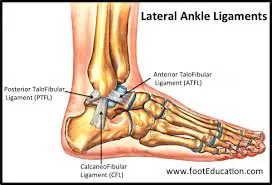
- Anterior talofibular ligament (ATFL) – the most frequently injured ligament
- Calcaneofibular ligament (CFL) – provides additional lateral stability
- Posterior talofibular ligament (PTFL) – involved in more severe injuries
These ligaments play a critical role in stabilizing the ankle during walking, running, jumping, and cutting movements. When they’re compromised, the ankle may feel painful, weak, or unstable — particularly during weight-bearing activities.
HOW DO LATERAL ANKLE SPRAINS HAPPEN?
Lateral ankle sprains often occur with a sudden and unexpected forceful inversion force (1). Common causes include:
- Stepping on uneven surfaces
- Landing awkwardly from a jump
- Sudden changes in direction or cutting movements
- Fatigue or poor neuromuscular control
- Previous ankle injuries that were not fully rehabilitated
Because the ankle absorbs large forces with each step, even everyday activities can result in injury.
THE SPECTRUM OF ANKLE SPRAIN INJURIES
Not all ankle sprains are the same. These injuries exist on a continuum of severity, and identifying where an injury falls on that spectrum helps guide treatment and recovery expectations (1,2).
- Grade I (Mild Sprain):
Ligaments are overstretched with minimal fiber damage. Pain and swelling are mild, and ankle stability is generally preserved. Most patients recover well with conservative care. - Grade II (Moderate Sprain):
Partial tearing of one or more ligaments. Pain, swelling, and bruising are more noticeable, and some instability may be present. Structured rehabilitation is essential. - Grade III (Severe Sprain):
Complete ligament rupture leading to significant instability and difficulty bearing weight. Surgery is rarely required, but advanced rehabilitation and careful progression are critical.
DIAGNOSIS: HOW IT’S IDENTIFIED
A proper diagnosis begins with a thorough history and physical examination (2). At M3 Chiropractic and Sports Medicine, we assess:
- Pain location and swelling patterns
- Range of motion and joint mobility
- Ligament integrity and ankle stability
- Balance, proprioception, and movement control
- Compensation patterns at the knee, hip, and foot
When appropriate, diagnostic musculoskeletal ultrasound allows us to visualize ligament damage in real time. This helps confirm injury severity, identify which ligaments are involved, and rule out associated injuries such as tendon damage or occult fractures.
WHY IMAGING MATTERS
Diagnostic ultrasound provides a fast, radiation-free way to assess ligament health and tissue integrity. For active individuals, this clarity helps establish realistic recovery timelines and ensures that rehabilitation is progressed appropriately.
Imaging also helps guide return-to-activity decisions and reduces the risk of reinjury or chronic ankle instability (3,4).
TO BRACE OR NOT TO BRACE?
When it comes to bracing after an ankle sprain, the latest evidence suggests that rigid, hard braces or prolonged immobilization are not usually necessary for most sprains. Traditional rigid supports that completely lock the ankle down haven’t been shown to improve long-term pain or function compared with more flexible, functional approaches, and may even delay return to normal movement if used for too long.
Instead, the focus in recent literature has shifted toward early controlled movement and functional support. That means encouraging safe walking and activity as soon as pain allows, supplemented by soft, semi-rigid, or lace-up braces or taping rather than hard immobilization. These options help provide stability while still allowing the joint to move, which supports proprioception and overall recovery. (5,6)
Rigid immobilization may still be used briefly in very severe injuries or when pain and swelling are significant, but for the majority of lateral ankle sprains, the trend is to avoid long-term hard bracing in favor of functional rehabilitation and earlier return to normal walking patterns.
TREATMENT AND REHABILITATION
Most lateral ankle sprains respond extremely well to structured, conservative care when treated properly (2).
PHASE 1: CONTROL PAIN AND RESTORE MOTION
Early care focuses on calming inflammation and restoring basic ankle movement. This may include:
- Soft tissue therapy (ART, Graston, cupping)
- Chiropractic adjustments to restore ankle and lower-extremity mechanics
- Shockwave or laser therapy to stimulate tissue healing
- Activity modification while maintaining pain-free movement
PHASE 2: RESTORE STABILITY AND PROPRIOCEPTION
As pain improves, rehabilitation shifts toward improving ankle control and balance.
- Continuation of appropriate manual therapy
- Balance and proprioceptive training
- Isometric and controlled strengthening exercises
- Addressing hip and knee mechanics to reduce ankle stress
PHASE 3: REBUILD STRENGTH AND LOAD TOLERANCE
Progressive loading prepares the ankle for real-world demands.
- Strengthening of the calf, peroneals, and intrinsic foot muscles
- Dynamic stability drills
- Gradual return to impact and directional change
PHASE 4: RETURN TO SPORT AND PREVENTION
The final phase restores confidence and long-term resilience.
- Sport-specific drills and movement retraining
- Plyometric and cutting progressions when appropriate
- Education on bracing, taping, and injury prevention strategies
At M3 Chiropractic and Sports Medicine, successful ankle rehabilitation isn’t just about eliminating pain — it’s about restoring strength, stability, and confidence so you can move without hesitation.
WORK WITH M3 CHIROPRACTIC & SPORTS MEDICINE
We offer comprehensive, evidence-based care for lateral ankle sprains at our Atlanta chiropractic clinic, including:
- Chiropractic adjustments or spinal manipulation
- Active Release Technique (ART)
- Graston Technique
- Class IV laser therapy
- Piezowave therapy (focused shockwave)
- Storz shockwave therapy (radial shockwave)
- Rehabilitative exercise
- RockTape application
- Activity modification and prevention guidance
When you’re ready to move better and reduce your risk of future ankle injuries, Dr. Drew and Dr. Paul are here to help you heal smarter and return stronger.
Contact us today to get started.
References:
- Bergman R, Shuman VL. Acute ankle sprain. In: StatPearls [Internet]. Treasure Island (FL): StatPearls Publishing; 2025 Jan–. Updated 2025 Aug 2. Available from: https://www.ncbi.nlm.nih.gov/books/NBK459212/
- Vuurberg G, Hoorntje A, Wink LM, van der Doelen BFW, van den Bekerom MP, Dekker R, van Dijk CN, Krips R, Loogman MCM, Ridderikhof ML, Smithuis FF, Stufkens SAS, Verhagen EALM, de Bie RA, Kerkhoffs GMMJ. Diagnosis, treatment and prevention of ankle sprains: update of an evidence-based clinical guideline. Br J Sports Med. 2018 Aug;52(15):956. doi: 10.1136/bjsports-2017-098106. Epub 2018 Mar 7. PMID: 29514819.
- Margetic P, Salaj M, Lubina IZ. The Value of Ultrasound in Acute Ankle Injury: Comparison With MR. Eur J Trauma Emerg Surg. 2009 Apr;35(2):141-6. doi: 10.1007/s00068-008-7174-1. Epub 2008 Sep 11. PMID: 26814767.
- Sayyed Hadi Sayyed Hosseinian, Behzad Aminzadeh, Amin Rezaeian, Lida Jarahi, Amirhossein Kasaeian Naeini, Puria Jangjui, Diagnostic Value of Ultrasound in Ankle Sprain, The Journal of Foot and Ankle Surgery, Volume 61, Issue 2, 2022, Pages 305-309, ISSN 1067-2516, https://doi.org/10.1053/j.jfas.2021.08.008.
- Dhillon S, Adhya B, Rajnish RK, Dhillon H. Lateral Ankle Sprain: Current Strategies of Management and Rehabilitation Short of Surgery. J Foot Ankle Surg Asia-Pacific 2022; 9 (1):46-49.
- Kerkhoffs GMMJ, Rowe BH, Assendelft WJJ, Kelly KD, Struijs PAA, van Dijk CN. Immobilisation and functional treatment for acute lateral ankle ligament injuries in adults. Cochrane Database Syst Rev. 2013;(3):CD003762. doi:10.1002/14651858.CD003762.pub2. Accessed 2026 Feb 04.