
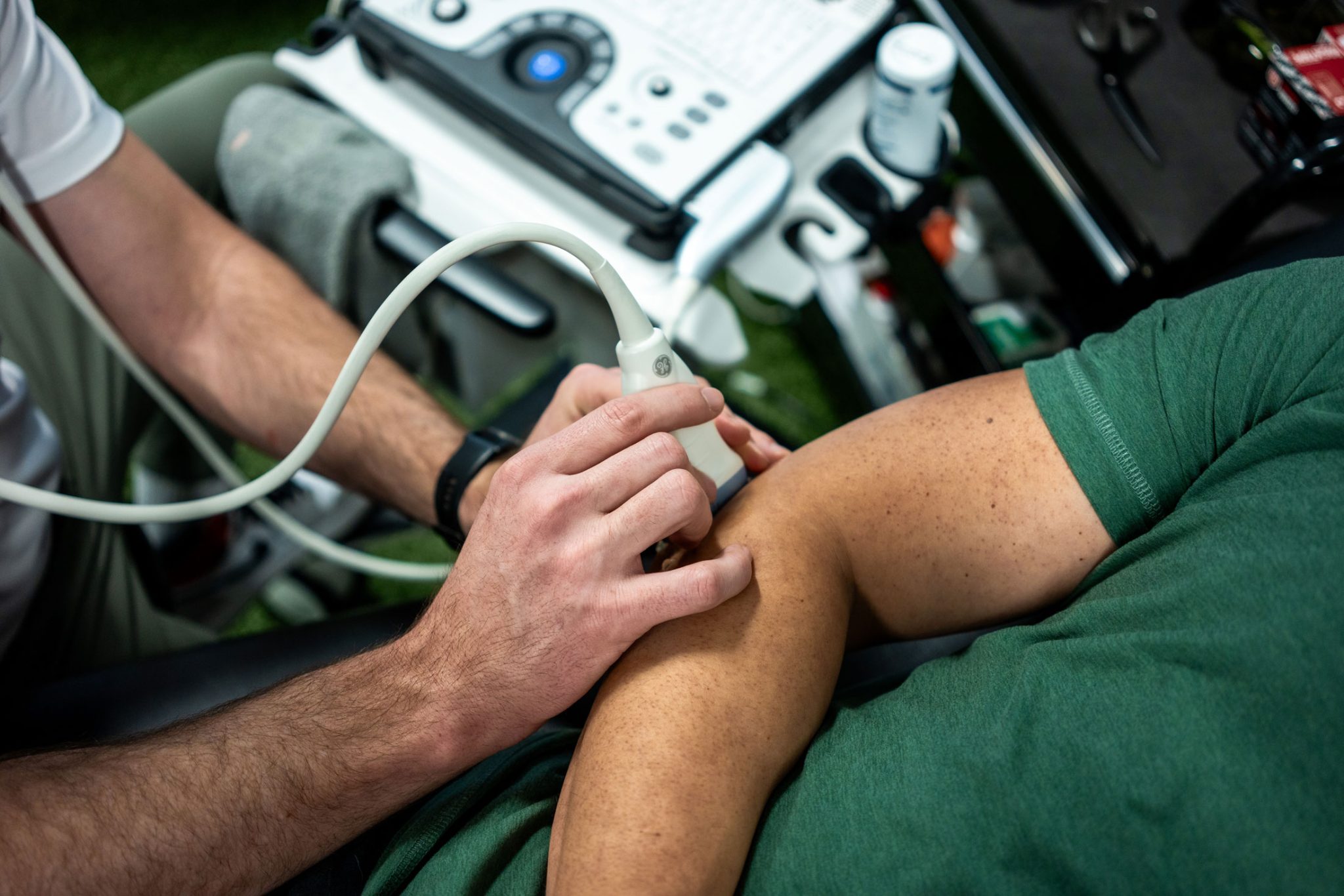
One of the primary advantages of musculoskeletal ultrasound is its ability to provide real-time visualization of soft tissues, tendons, ligaments, muscles, and nerves. Unlike MRI or X-rays, which provide static images, ultrasound allows clinicians to dynamically assess the affected area during movement, providing valuable insights into the extent of the injury and its impact on function. This real-time feedback not only aids in accurate diagnosis but also enables clinicians to monitor the progression of healing over time, guiding rehabilitation protocols and return-to-play decisions.

Diagnostic ultrasound is an imaging technology that allows us to view your body using sound waves. Sound waves are emitted from the transducer at a certain wavelength. These sound waves travel to tissue and return to their original source, creating a picture on screen. Diagnostic ultrasound has many advantages as an imaging tool. It is inexpensive, the patient is not restricted to a confined space, so it’s also comfortable to undergo an ultrasound procedure. Imaging can be obtained dynamically, meaning the patient can perform movements while the procedure is taking place so the sonographer can see what the tissue does during movement. This is not possible with X-ray or MRI.
What is Diagnostic Ultrasound Best at Viewing?
Ultrasound excels at viewing soft tissues all over the body. Within the scope of chiropractic care and sports medicine, ultrasound can be used to image tendons, ligaments, muscles, nerves, blood vessels, and even bone. At M3 Chiropractic & Sports Medicine, we use ultrasound to view various sports injuries such as tendonitis (Ex: tennis elbow, achilles or patellar tendonitis), muscle and tendon strains (Ex: pulled hamstring or quad), ligament sprains (Ex: ankle sprains), and nerve compression syndromes (Ex: carpal tunnel or tarsal tunnel syndrome). Once we’ve obtained a diagnosis, that information is used to guide our treatment strategy. Often, confirming a diagnosis with ultrasound allows us to create a conservative treatment plan designed to rehab and renew the patient so that they can get back to playing their sport or living their lives pain-free. Occasionally, a finding will reveal that a referral to another provider is recommended.


What Are the Most Common Findings with Diagnostic Ultrasound?
Using diagnostic ultrasound, we frequently identify a range of conditions. Some of the most common findings include:
- Tendonitis: Inflammation of the tendons, often caused by overuse injury.
- Muscle and Tendon Strains: Tears or overstretching of muscle fibers or tendons, common in athletes and active individuals.
- Ligament Sprains: Damage to ligaments, which connect bone to bone and stabilize joints.
- Nerve Compression Syndromes: Conditions such as carpal tunnel syndrome, where nerves are compressed, leading to pain and numbness.
- Bursitis: Inflammation of the bursae, the small sacs of fluid that cushion joints.
- Joint Effusions: Accumulation of fluid within a joint, indicating chronic irritation, inflammation, or acute injury.
These findings help us tailor our treatment plans to the specific needs of each patient, ensuring the most effective and efficient path to recovery. They also help us dial in our treatment to be as specific as possible to the site of tissue injury.
